
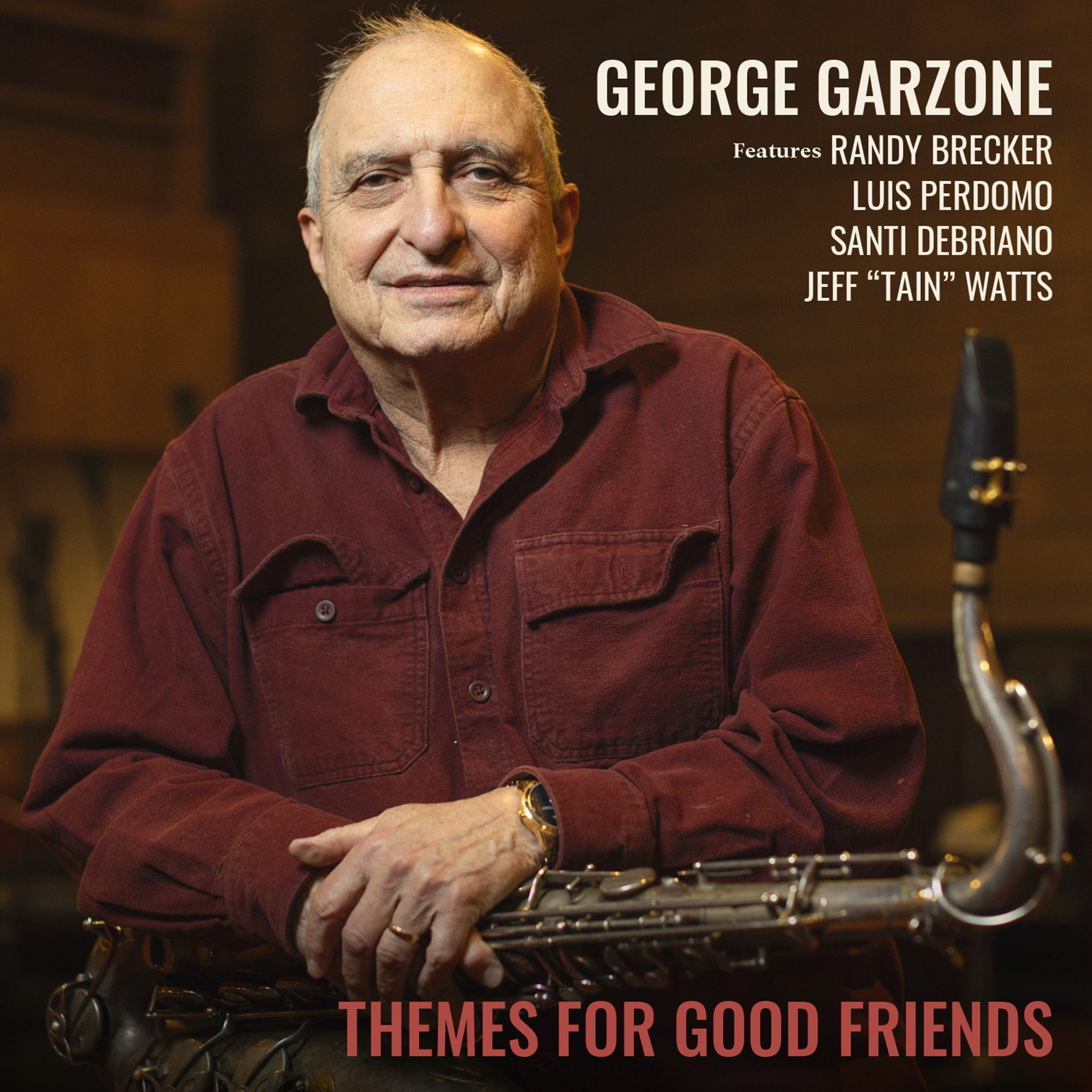
George Garzone Returns with New All-Star Quintet Recording Featuring Randy Brecker, Santi Debriano, Luis Perdomo & Jeff “Tain” Watts on Themes for Good Friends, due out September 11, 2026 via Jojo Records
There are few musicians in jazz whose influence exceeds their discography quite like tenor saxophonist George Garzone. For more than fifty years, Garzone has occupied a singular place in the music as one of the defining voices of the modern tenor saxophone, and a revered educator whose students have gone on to shape contemporary jazz themselves. Joshua Redman, Branford Marsalis, Donny McCaslin, Mark Turner, Seamus Blake, Chris Cheek, and countless others all passed through his classroom at Berklee College of Music, where this year Garzone celebrates his fiftieth year on the faculty. Long regarded as the quintessential musician’s musician, Garzone now returns with Themes For Good Friends – a remarkable new recording that celebrates both his enduring artistry and the musical relationships forged over a lifetime – due out September 11, 2026 via Jojo Records.
Born and raised in Boston, Garzone continues to play with the same harmonic sophistication and fearless curiosity that has defined his career for decades. “When I was ten or eleven,” Garzone recalls, “I first heard the tenor playing of Stan Getz on a record. It changed my life.”
That lifelong pursuit of sound is fully realized on this new album, which brings together an extraordinary quintet featuring trumpeter Randy Brecker, pianist Luis Perdomo, bassist Santi Debriano, and drummer Jeff “Tain” Watts. Each musician is an acclaimed bandleader and improviser in their own right, yet together they create a unified ensemble built on decades of shared experience and uncompromising musicianship.
The recording came together following a chance moment of inspiration. After leaving a Garzone club performance in New York completely captivated, Jojo Records producer Simon Belelty approached Debriano about assembling a session worthy of Garzone’s artistry. Debriano and Garzone first met as students in Boston around 1970 and have shared bandstands throughout their careers. When Debriano proposed a quintet featuring Brecker, Perdomo, and Watts, Garzone immediately embraced the idea. It was a natural fit: five masters coming together for a program steeped in straight-ahead jazz.
The repertoire reflects both Garzone’s personal history and the breadth of his musical vision. Original compositions including Debriano’s “Ripty-Boom” and Garzone’s “Mingus That I Knew” and “To Michael Brecker” appear alongside inspired interpretations of Archie Shepp’s “U-Jaama,” the classic “Just Ring the Bell,” a playful contrafact of Jimmy Van Heusen’s “It Could Happen to You” retitled “It Will Happen to You,” and two striking duo performances.
Opening the album is John Coltrane’s “Theme for Ernie,” performed as an intimate duet between Garzone and Luis Perdomo. The performance serves as both an homage to Coltrane, whom Garzone has often referred to as “the Supreme Being,” and to Stan Getz, whose lyricism first inspired him to pursue the tenor saxophone. The purity of Garzone’s tone and the spacious dialogue with Perdomo immediately establish the album’s emotional depth.
The full quintet arrives on Archie Shepp’s “U-Jaama,” where Jeff “Tain” Watts anchors the ensemble with characteristic power before launching into a commanding solo of his own. Throughout the session, bassist Santi Debriano provides the rhythmic foundation that allows the music to swing effortlessly while giving each voice room to emerge.
“It Will Happen to You” demonstrates Garzone’s wit as an arranger. Built upon the harmonic framework of Jimmy Van Heusen’s beloved standard “It Could Happen to You,” the piece transforms familiar material into a joyful modern swing vehicle. Randy Brecker delivers a trumpet performance filled with warmth and invention, while Perdomo contributes an exuberant piano solo before the piece concludes with a spirited exchange between Debriano and Watts.
Debriano’s own composition, “Ripty-Boom,” provides one of the album’s most expansive performances. Every member of the quintet stretches freely, creating a richness of texture that belies the ensemble’s modest size. The chemistry between the five musicians reflects years of experience and shared musical language.
Among the album’s most personal moments is Garzone’s “To Michael Brecker.” Garzone composed the piece immediately after receiving a phone call from Joe Lovano informing him of Michael Brecker’s passing in 2007. With Michael’s brother Randy present for the recording, Garzone made the unusual decision to forgo traditional improvisational solos. Instead, tenor saxophone and trumpet remain intertwined throughout the performance, sharing a single melodic statement that becomes a moving tribute to one of jazz’s most beloved voices.
Garzone’s “Mingus That I Knew” carries a similarly memorable backstory. While its shifting tempos pay subtle tribute to Charles Mingus’s compositional language, the title refers to an unforgettable encounter Garzone experienced as a young student during a visit to the Village Vanguard. As Dutilh recounts, Garzone unknowingly asked the man seated behind him to stop smoking his cigar during intermission, only to discover moments later that the smoker was Charles Mingus himself.
The album also includes one of its boldest artistic statements in a remarkable duet between Garzone and Jeff “Tain” Watts on John Coltrane’s “Giant Steps.” For nearly the entire performance, Garzone deconstructs the composition through searching improvisation and harmonic exploration before revealing the familiar melody only in the closing moments. Fittingly, it was the final piece recorded during the session at Rudy Van Gelder’s legendary studio, where so much of jazz history continues to resonate.
For all of Garzone’s accomplishments as a performer, his influence extends equally through his work as an educator. Reflecting on five decades of teaching, he often says, “A good teacher is a teacher who can teach you to teach yourself.” His classroom has shaped generations of improvisers, but his own artistic curiosity remains undiminished. He continues to approach each recording as both master and student, exploring new harmonic possibilities while remaining deeply connected to the lineage that first inspired him.
As T.J. English writes in his accompanying liner notes, Garzone’s sound bridges the entire history of the tenor saxophone. It carries the daring of John Coltrane, the lyricism of Stan Getz, and a voice that is unmistakably his own. This new recording is more than a gathering of extraordinary musicians. It is a portrait of an artist who continues to evolve after more than fifty years, reaffirming George Garzone’s place among the defining tenor saxophonists of his generation.
##