
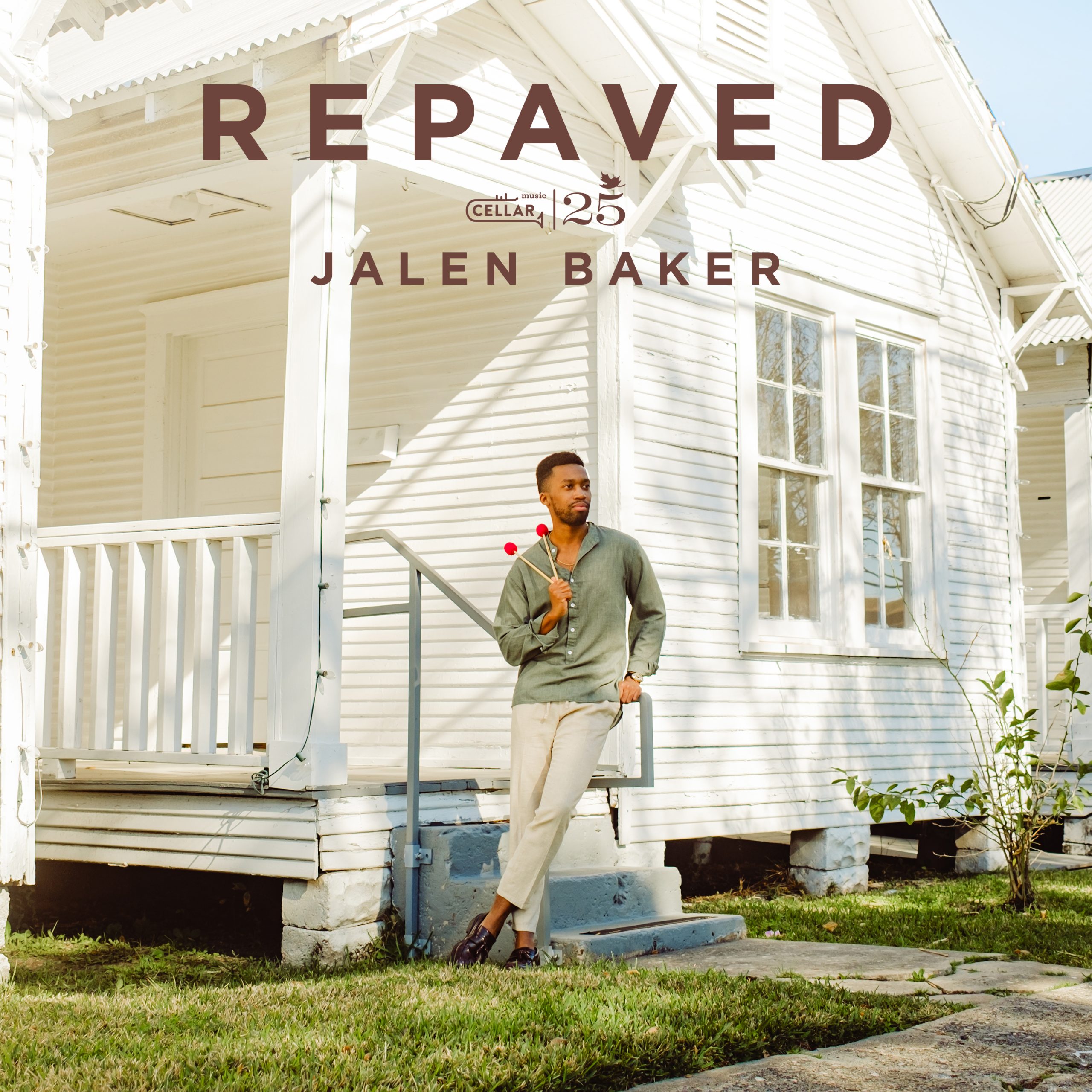
Vibraphonist and composer Jalen Baker celebrates and preserves the legacies of Houston’s historic Black neighborhoods facing gentrification with RePaved
out September 4, 2026 via Cellar Music Group
While some people may be aware of their genealogies, vibraphonist and composer Jalen Baker can trace his family history not only to a region, tradition, or person, but with great detail, back four generations, to the same neighborhood: Houston, Texas’s 3rd Ward. The area stands alongside its fellow 4th and 5th Wards as three of Houston’s historic Black neighborhoods that are now on the precipice of historical and cultural erasure in the face of gentrification. As the vibrant legacy of these culturally rich neighborhoods started to border on being lost, Baker began diving deeply into research to pen the stories of generations of Black Americans onto paper and into music. Standing with a jazz quintet made of predominantly fellow Houstonians coupled with evocative string quartet writing, Baker presents his third album as a leader, RePaved, an anthemic eight-part suite that proclaims the stories of these three wards.
Out on September 4th via Cellar Music group, the album’s title, RePaved, is a direct allusion to the method in which the physical neighborhoods and their corresponding histories are attempting to be overturned. By harkening to the act of paving over physical history, Baker highlights the stories and generations that could just as easily be forgotten when the tangible reminders no longer remain. “RePaved is meant to shed light on the idea that these historical neighborhoods in not only Houston but all over the world are being gentrified and their history being erased,” Baker says. “This record is my way of preserving and educating listeners on history that is personal to me and that I feel is incredibly important.”
Musically, the album is textured by its less-than-common instrumentation: a jazz quintet with flute and vibraphone, plus a string quartet, all neatly wrapped in the bow of modern jazz and steeped within the history of jazz. Compositionally, Baker’s writing presents something new and subtle for a listener to latch onto. As one focuses in, each work presents a bounty of subtle, tastefully placed countermelodies, moving bass lines, and rhythmic counterpoint. This motion, coupled with Baker’s masterful orchestration, keeps the music intricately woven in such a manner as to never feel crowded while always keeping the mind intrigued.
As befits an album that is an homage to history, each track evokes a specific piece of Houston’s neighborhoods. The album’s opening track is entitled “Antioch,” named after the first Black baptist church that opened in Texas. The church was founded by the recently freed slaves after emancipation in Texas on Juneteenth. The piece, with its organ sounds and overlapping melodies, pays respect both to the physical church and its founder, John Henry “Jack” Yates.
The themes and histories of freedom are continued with “Dowling/Emancipation,” a piece thus titled after the changing of a notable street name. In 2017, a major street running through the center of 3rd Ward was renamed. Formerly “Dowling,” named after a Confederate officer, the thoroughfare was jubilantly renamed “Emancipation.” This piece expertly showcases Baker’s ability to weave together 3rd Ward’s past and present musically and narratively with a spirit of celebration for such a cultural victory. “For me,” Baker says, “the renaming of this street signified the taking back of something that belonged to the Black residents of Houston’s 3rd Ward.”
“City on the Water” presents a sobering contrast, yet one that still celebrates the communities within Houston. Written to bear witness to the resilience of Houstonians, “City on the Water” is a ballad that recalls the events of environmental tragedies such as Hurricane Harvey while testifying to the strength of the people to withstand it. Propelled by a lyrical yet pensive flute solo from Alexandria DeWalt, this track sings the spirit of a city that is able to weather the storm again and again.
In creating RePaved, Baker worked with his longstanding quintet of cohorts, with the ebullient layer of a string quartet added in and around, evoking the long-form suites of many of this suite’s influences such as Duke Ellington, Wynton Marsalis, and Billy Childs. The jazz quintet on RePaved comprises: Jalen Baker (vibraphone, composer), Alexandria DeWalt (flute), Paul Cornish (piano), Gabriel Godoy (bass), and Gavin Moolchan (drums). The string quartet comprises: Yoojin Park (violin), Chiara Jamila (violin), Tia Allen (viola), and Reenat Pinchas (cello).
From the first notes of the opening track, “Antioch” to the final chords of its closing “Smile,” RePaved stands as a profound work that stretches far beyond the individual and proclaims the message of the history which it represents. With RePaved, Baker has created something far more than music; he has created an oral history, of sorts, and an obelisk that, like the stories it represents, will remain. RePaved is a powerful ode to the legacy of a robust, bold, and resilient people who have formed the heartbeat of Houston for generations and will continue to do so for generations to come.
RePaved released September 4, 2026 via Cellar Music Group.