
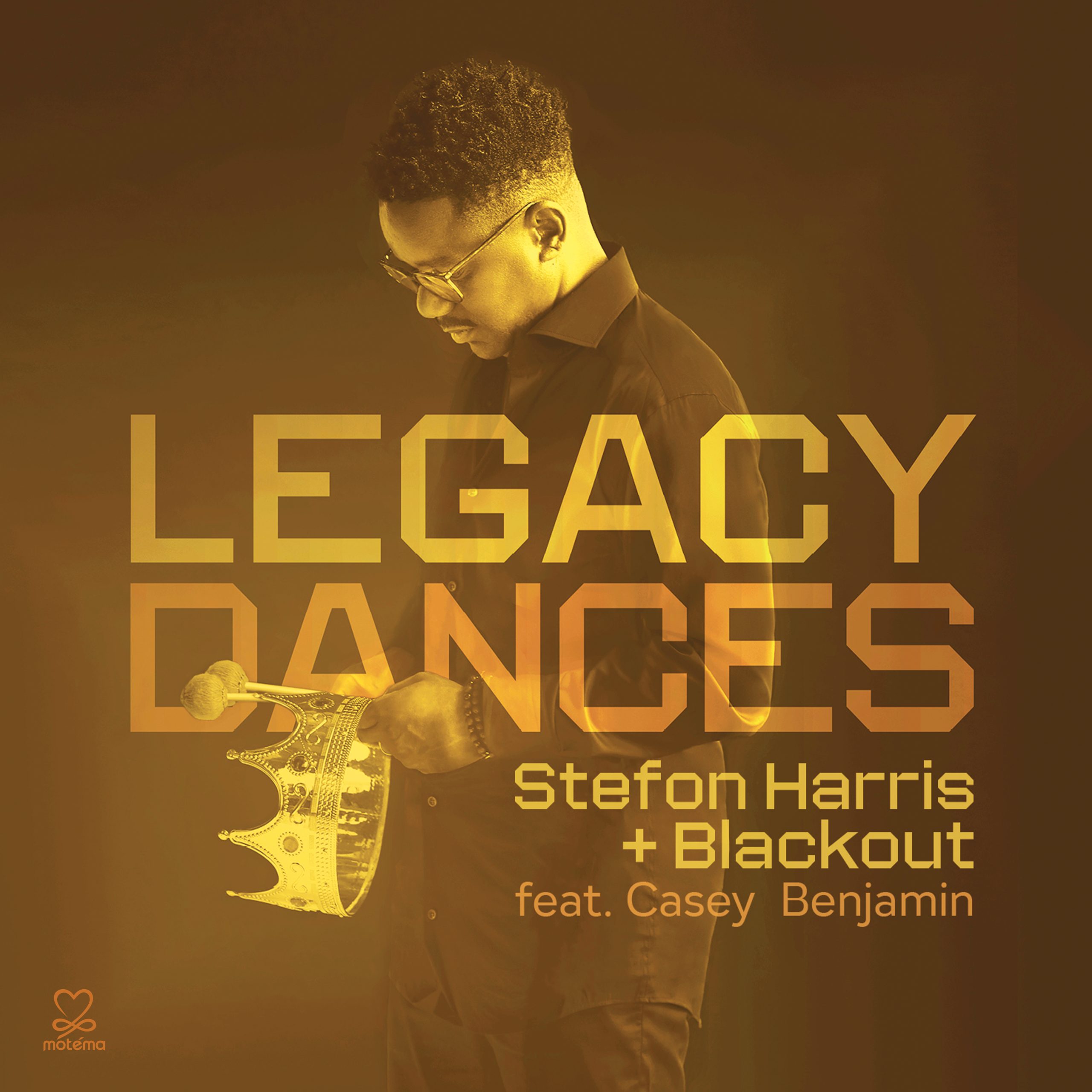
Stefon Harris Honors Ancestral Legacies, Community, and the Life of Casey Benjamin on Legacy Dances
Out August 28, 2026 via Motéma
4x GRAMMY®-nominated vibraphonist, composer, educator, and arts leader Stefon Harris celebrates 20 years of his groundbreaking band, Blackout with Legacy Dances, a vibrant recording inspired by ancestral influences, the importance of community, and Harris’s belief in jazz as a living, ever-evolving art form that must be rooted in exacting artistry, deep personal connection, and limitless imagination.
The release is bittersweet for Harris, as it both gloriously features and poignantly pays tribute to the extraordinary talents of electro-jazz innovator Casey Benjamin, an essential founding member of Blackout in 2004 and one of Harris’s dearest friends. The devastating shock of Benjamin’s sudden death in 2024 halted the band’s 20th Anniversary celebrations. Now, after taking time to reflect and consider next steps, Harris and Blackout look forward to honoring their newly ascended ancestor’s legacy with this landmark recording while dancing forward into exciting new Blackout directions.
As Harris’s fifth Blackout release and eleventh album as a leader, Legacy Dances is set to arrive on August 28, preceded by the vocal singles “I Know Love” (May 8) and “What a Wonderful World” (June 5), each illuminated by Benjamin’s prodigious vocoder gifts, as well as Harris’s instrumental tour de force originals “Echoes of the Lion” (July 3) and “A Radical’s Love” (July 31). Together with the album’s seven remaining tracks, they underscore the excellence and enduring appeal of this iconic ensemble.
Blackout broke new ground on their debut, Evolution (Blue Note, 2004), combining thrilling virtuosity with elements of hip-hop, fusion, funk, R&B, ancestral rhythms, and more. Harris’s jaw-dropping speed and musicality on vibraphone and marimba, alongside Marc Cary’s piano and synth inventions, Terreon Gully’s rhythmic architecture, and especially Benjamin’s joyous and virtuosic experimentation saxophone filtered through electronic sound-manipulation devices, established the group both collectively and individually as leaders of a new era in jazz. Later, Benjamin’s vocoder and aerophone would add more creative dimensions to Blackout’s sound.
“Every once in a while, a truly original being shares this limited space and time with us,” extols Harris. “Casey occupied a rarefied space brimming with genius, audacity, kindness, and humility. We were all incredibly lucky to have been blessed with the opportunity to create beauty with a true musical master.”
Through the years, the group has evolved, and Harris has consistently emerged as a thought leader in jazz and music education, as well as in empathy-based corporate team-building through the development of listening and communication skills. In producing, arranging, and writing Legacy Dances, he centered on the idea of jazz as ‘Empathy in Action’. “Embedded in the DNA of jazz is a blueprint for the transformative power of empathy,” Harris explains in the liner notes. “Our ancestors left us transformational tools that continue to empower us to understand and amplify the voices of our community.”
That intent runs throughout the album as the music honors lineage and collective experience through infectious compositions and fearless improvisation. The title track bursts out of the gate with Harris’ vibes and Benjamin’s sax doubling the memorable melody atop a surging groove from the rhythm section, powerfully propelled by Christian Sands’ piano on his first Blackout recording, the artists break into a rolling series of blistering solos. The ensemble’s balance of structure and spontaneity reflects Harris and Benjamin’s shared philosophy, expertly supported by the unerring groove and deeply informed rhythmic passion of Terreon Gully’s drums and Dezron Douglas’ muscular walking bass, and djembe master Weedie Braimah .
While introducing six new Harris classics to the lexicon, Legacy Dances pays tribute to seminal jazz ancestor Louis Armstrong with fresh interpretations of “What a Wonderful World” and “West End Blues.” Harris also honors Newark’s own Willie “The Lion” Smith with his ingenious “Echoes of the Lion.” The composition abstracts the left-hand ostinato from Smith’s “Echoes of Spring” and places it in a contemporary musical context where melody and harmony emerge through the rhythmic crevices of the underlying bass groove.
Other originals draw inspiration from family, mentors, and cultural visionaries, including Newark born poet and activist Amiri Baraka, whose life and philosophy profoundly influenced Harris. “Legacy lives not only in the art our ancestors left behind,” Harris writes, “but also in the social rhythm of the cities and people that helped cultivate that artistry. I am committed to utilizing my artistry to celebrate the heroes of the community I serve.”
This release arrives during an especially dynamic period in Harris’s multifaceted career. Alongside performing and recording, he holds a tenured faculty position at Rutgers University, serves as co-director of the innovative arts space Express Newark, and tours universities and conservatories promoting Harmony Cloud™, his revolutionary ear-training and improvisation platform developed over the past decade which officially launched at the 2026 Jazz Education Network Conference in January. The popular app already has thousands of users, and Harris has conducted Harmony Cloud workshops at institutions including Harvard University, Peabody Conservatory, Temple University, the University of Miami, the University of Oregon, and the University of Southern California, with additional engagements forthcoming across the U.S. and abroad.
With Legacy Dances, Harris brings together his work as an artist, educator, and cultural leader while offering a heartfelt farewell to a beloved collaborator. “Alone and together, we dance,” Harris writes. In that spirit, he invites listeners to experience the music as a shared act of listening, learning, dancing and human connection.
Meanwhile, the legacy of Casey Benjamin continues to unfold. As listeners around the world continue to engage with and be influenced by his work with Blackout, the Robert Glasper Experiment, and a wide range of artists across jazz, hip-hop, and popular music, his brother Kevin is producing a documentary and working with Benjamin’s close collaborator Blair Wells to master and assemble two albums that Benjamin had nearly completed. These forthcoming posthumous releases will ensure that his music and influence continue to resonate for generations to come.
More About Casey Benjamin
(Excerpts from WBGO’s Casey Benjamin tribute by Angelika Beener)
“It’s hard to encapsulate all that Casey is to music. He was a polymath. A virtuosic saxophonist, multi-instrumentalist (alto, tenor, and soprano sax; keyboards, vocoder, aerophone), writer, arranger, producer, and DJ. Yet, it is Casey’s synthesis, his approach as a musician and technologist, his mastery, feel, and melodic ingenuity, that distinguished his giftedness from all others of that rare caliber. A wizard of sound and texture, Benjamin pioneered a unique lane that shifted music and culture.
It was his distinctive magic that made a wide spectrum of elite artists seek him out, including Patrick Stump (Fall Out Boy), Kendrick Lamar, Lady Gaga, John Legend, Anderson .Paak, Nas, Common, Arcade Fire, Beyoncé, Kanye West, Wyclef Jean, Pusha T, Maxwell, Solange, Drake, and so many more. His close collaborations with hip hop legend Q-Tip, and contemporaries vibraphonist Stefon Harris and pianist-arranger-producer Robert Glasper, helped lead a movement to expand the ways in which we create, talk about, and experience black music, and reimagine and reconsider how we conceive the possibilities of jazz.”
– Angelika Beener, WBGO – Tribute Article
Tour Dates
Jul 23 – Stanford University, CA
Sep (18-21 – Date Tbc) – Jazz By The River, PA
Oct 5, 6 – Blue Note, NY, NY
Oct 13,14 – Jazz Alley, Seattle, WA
Oct 23-25 (Date Tbc) – Exit Zero Jazz Fest, Cape May, NJ
Stefon Harris has initiated a popular line of signature Malletech mallets and helped to develop Malletech’s revolutionary OmegaAir Vibraphone which made its recording debut on Legacy Dances. https://malletech.com/artist/stefon-harris/