
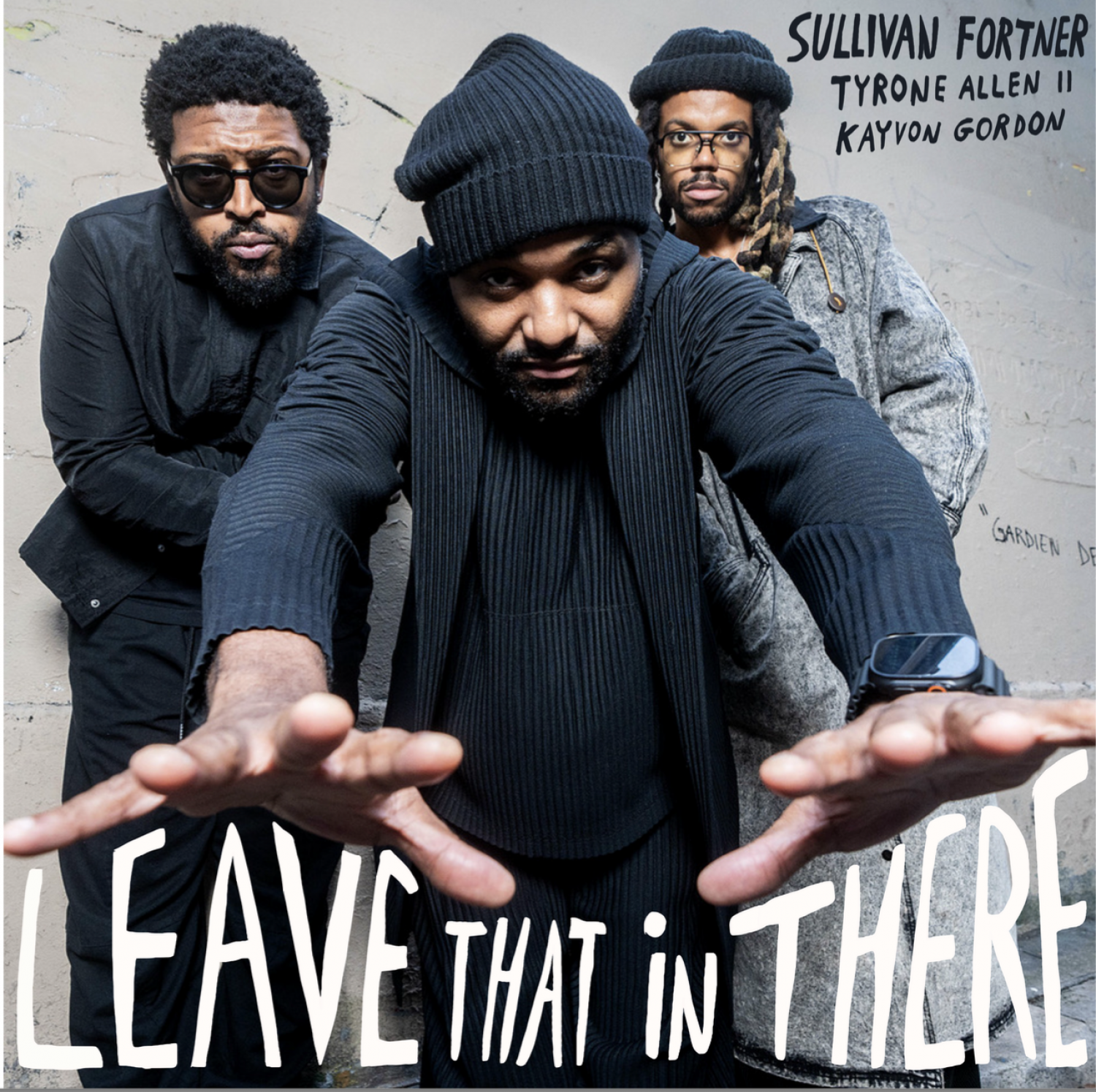
GRAMMY Winning Pianist Sullivan Fortner Announces New Album Leave That In There – out August 28 via Artwork Records
Artwork Records is thrilled to announce the August 28, 2026 release of Leave That In There, the sixth album by GRAMMY Award-winning pianist, composer, and bandleader Sullivan Fortner. Co-produced by Derrick Hodge and Jack DeBoe, Leave That In There presents Fortner’s most personal and self-referential statement to date. Across a dozen original compositions and one cover, the New Orleans native threads together musical references, memories pulled from family history, spiritual traditions, and sonic callbacks to earlier works throughout his catalog. The album moves fluidly between acoustic trio interplay, Hammond B3 organ, synthesizers, marimba, Bàtá drumming, and fully improvised passages while maintaining the connective language that has defined Fortner’s music since his debut over a decade ago. This is the first studio recording featuring his working trio comprising bassist Tyrone Allen II and drummer Kayvon Gordon.
Fortner recently earned the GRAMMY Award for Best Jazz Instrumental Album for his previous album Southern Nights, adding to a career that has established him as one of the defining pianists of his generation. He previously received a GRAMMY for his work with vocalist Samara Joy and has performed and recorded alongside artists including Cécile McLorin Salvant, Wynton Marsalis, Paul Simon, Dianne Reeves, and John Scofield, and has received countless accolades and recognition, including the The Gilmore’s inaugural 2026 Larry J. Bell Jazz Artist Award. Fred Kaplan of Slate referred to Fortner as “simply one of the best jazz pianists playing.”
The album title comes from a line in When the Levees Broke: A Requiem in Four Acts, Spike Lee’s 2006 documentary chronicling the devastation following Hurricane Katrina. In the liner notes, writer Courtney-Savali L. Andrews recounts Fortner’s deep connection to the phrase and the layered meanings it carries within the record’s broader themes of memory, survival, humor, grief, ancestry, and resilience. Andrews describes the album as “his most self-referential work to date,” noting that Fortner sought to create “a catalogue of music that is connected.”
Raised in New Orleans, Fortner draws heavily throughout the album from the Gulf South, its landscapes cultural, musical, and historical. Opening track “Sugarcane” serves as an entry point into many of the album’s broader themes, drawing from both Fortner’s personal history and the deeper historical landscape of southern Louisiana, where he was raised. Built around Kayvon Gordon’s Bàtá drumming and layered rhythmic interplay between the trio, the composition reflects Fortner’s ongoing engagement with Black diasporic musical traditions while also referencing the histories of labor, migration, and resistance tied to Louisiana’s sugarcane industry. In the liner notes, Andrews connects the piece to the history of the 1811 German Coast uprising, the largest revolt led by enslaved Africans in American history, which took place near LaPlace, the town where Fortner grew up.
The composition also draws from Fortner’s own childhood memories. “Everybody knows what sugarcane is,” he recalls in the liner notes. “My grandmother used to come over with stalks of sugarcane. You would cut it, we would sit there, eat it and spit it out on the ground. That’s how I learned how to sweep as a kid.” Andrews describes the track as reflecting both the responsibilities and musical values Fortner inherited growing up, while the arrangement itself moves between acoustic piano, marimba, synthesizer textures, and layered percussion that subtly reference artists including Stevie Wonder, George Duke, and Bernie Worrell. The musical material introduced in “Sugarcane” later reappears elsewhere on the album, reinforcing the interconnected structure that runs throughout Leave That In There.
The trio of Fortner, Allen, and Gordon has steadily developed into one of the pianist’s most cohesive ensembles in recent years. Andrews writes that the album documents “the first [record] as the frontman to this consistent lineup,” capturing a band shaped through ongoing performance rather than a one-time studio session. Their interplay across the album balances precision with spontaneity, allowing Fortner’s compositional structures and improvisational instincts to coexist naturally within the same musical language.
Leave That In There features a dozen originals, composed by Sulivan or fully improvised in the studio with the trio. Among the album’s other highlights are “Swirl,” a new original composition inspired by Thelonious Monk, the meditative tribute to the late Mama Payne, “A Hymn for Linda,” “Aria II,” which revisits material from Fortner’s 2015 debut album Aria, and the contemplative lead single “Que Diablos”, The sole cover is “Number 3”, which is a fast waltz written by Detroit’s own drummer-composer Lawrence Willians. A staple in Marcus Belgrave’s repertoire – who Sullivan met while at Oberlin – the track is a tribute to him.
Throughout the project, Fortner revisits earlier musical ideas not as nostalgia, but as part of an evolving continuum. As Andrews writes Leave That In There serves as “another sound collage” that lays bare Fortner’s “histories, logics, desires, priorities, and concerns.”
With Leave That In There, Sullivan Fortner expands the scope of the piano trio format while deepening the personal and musical threads that have run through his work from the beginning.
Tracklisting:
- Sugarcane
- Que Diablos
- A Poignant Time
- Aerobatics Pt. 1
- Aerobatics Pt. 2
- Sorcerer’s Stick
- Swirl
- T295
- Number 3
- 12 Gallons
- Aria II
- A Hymn for Linda
- Another Poignant Time