
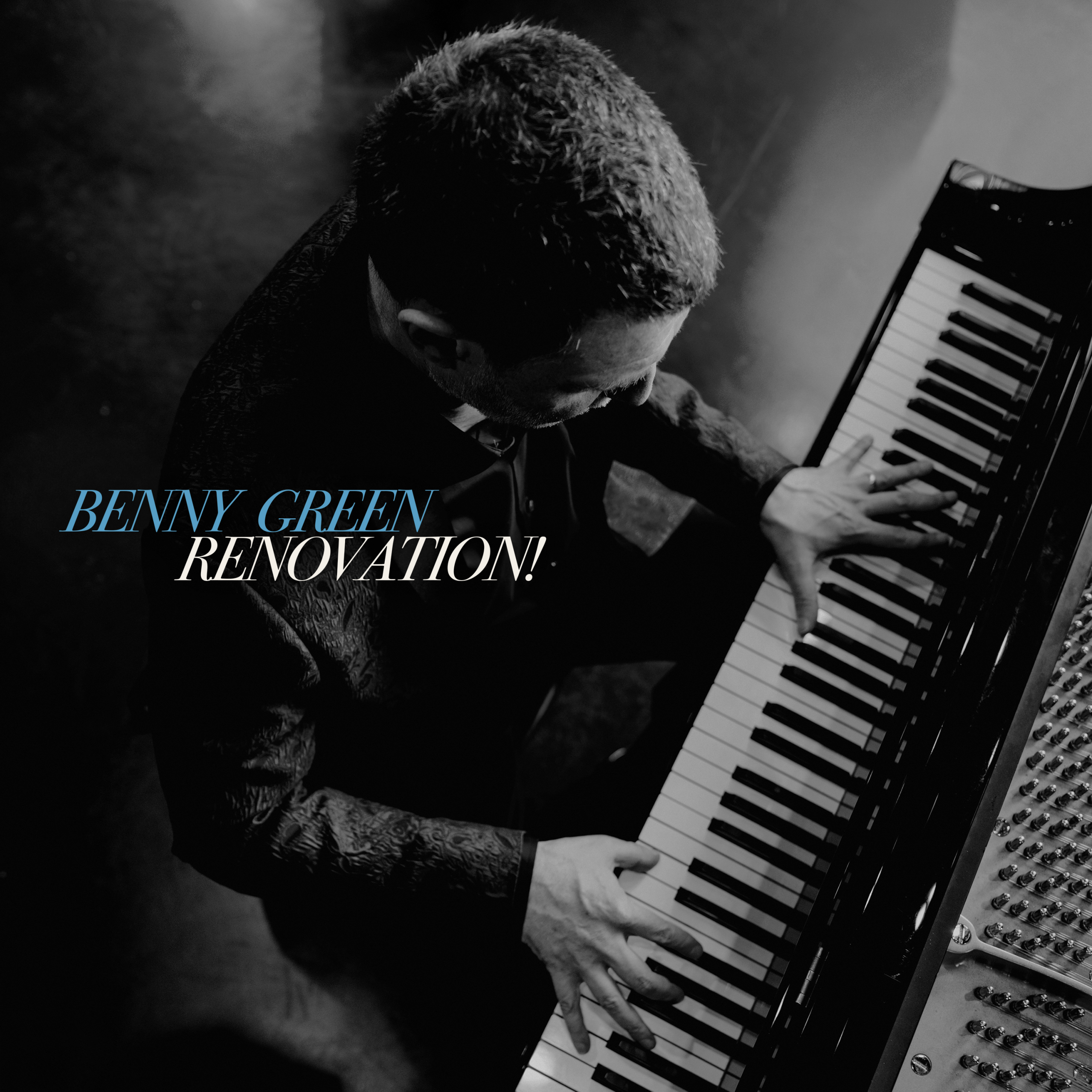
OSCAR PETERSON PROTÉGÉ, JAZZ MESSENGER AND ACCLAIMED PIANIST-COMPOSER BENNY GREEN ANNOUNCES RENOVATION
RECORDED LIVE AT DIZZY’S CLUB IN NEW YORK CITY, GREEN’S FIRST LIVE SOLO PIANO ALBUM DRAWS FROM FOUR DECADES OF TRIO LANGUAGE AND BLUE NOTE FEELING
FEATURING EIGHT GREEN ORIGINALS ALONGSIDE PIECES BY BOBBY TIMMONS, RANDY WESTON, HOAGY CARMICHAEL & FRANK LOESSER, AND MATT DENNIS & TOM ADAIR
OUT SEPTEMBER 18, 2026 VIA SUNNYSIDE RECORDS
Pianist, composer and bandleader Benny Green is proud to announce Renovation, his new solo piano album, out September 18, 2026 on Sunnyside Records. Recorded live at Dizzy’s Club in New York City, the 13-track album marks his first live solo recording, with eight Green originals alongside pieces by Bobby Timmons, Randy Weston, Hoagy Carmichael & Frank Loesser, and Matt Dennis & Tom Adair.
“With my performing and recording activities of the past 40-plus years having been primarily centered around piano-bass-drums trios, I embraced the solitude of the 2020 lockdown as a golden opportunity to redirect my instrumental focus toward exploring the expansive freedom that playing solo provides me,” Green says.
“As Harold Mabern Jr. has said, ‘The piano knows what it can do — it wants to hear what you can do,’” he continues. “And I realized that liberated from the inevitable chemistry parameters that are conditionally subjective to whom I’m playing with, I can roam wherever I choose when playing solo, free from the need to cue other members to unscripted, spontaneous musical gear changes in the moment.”
Critics have recognized Green’s authority for decades. Leonard Feather of the Los Angeles Times called Green the “prototypical modern jazzman”; All About Jazz called him “one of the most gifted jazz pianists around” and a “consummate jazz pianist”; and DownBeat, writing on his 2023 Sunnyside album Solo, described “the master pianist in transition.”
Oscar Peterson named Green his protégé in 1992, chose him as the first recipient of Toronto’s Glenn Gould International Protégé Prize in Music, and later invited him to record the two-piano album Oscar and Benny.
Born in New York City in 1963 and raised in Berkeley, California, Green first heard jazz through his father, a tenor saxophonist whose record collection included Thelonious Monk, Charlie Parker, Billie Holiday, Ray Charles and many of the music’s founding voices. He began piano lessons at 7, played his first paid performance at 12, made his major concert-stage debut at 15 with the Monterey Jazz Festival High School All-Stars, and by his late teens was working with vocalist Faye Carol and NEA Jazz Master trumpeter Dr. Eddie Henderson.
In 1982, at 19, he returned to New York City, where Walter Bishop Jr. and Walter Davis Jr. mentored him during his first year in town, and where his earliest gigs included work with Barry Altschul, Bobby Watson and Jo Jones Jr.
Betty Carter hired Green in 1983, beginning four years of international touring with the vocalist. He played on her Grammy Award-winning Verve album Look What I Got before joining Art Blakey and the Jazz Messengers from 1987 to 1989. He joined Freddie Hubbard’s quintet in 1989 and recorded Live at Fat Tuesday’s with Hubbard in 1992. That same year, he joined the Ray Brown Trio, his longest sideman tenure, remaining with Brown for four and a half years.
As a leader, Green recorded two albums for the Dutch Criss Cross label in the late 1980s before signing with Blue Note Records in 1990, where he made seven leader albums across the decade, plus two for Toshiba-EMI. He went on to record for Telarc, including his 2001 solo piano album Green’s Blues and two duo albums with guitarist Russell Malone. In 1998, Peterson invited Green to record Oscar and Benny. In the 2010s, Green began recording for Sunnyside, with albums including Magic Beans, Live in Santa Cruz, Happiness, Then and Now, Benny’s Crib and Solo.
During Green’s Jazz Messengers tenure, Blakey would sometimes turn off his snare drum and send the other musicians offstage mid-set, leaving Green alone to play a long solo piano medley. In the studio in Milan in 1988, while recording his first album as a member of the Messengers, Blakey also gave him the chance to play what became the only solo piano track in the Jazz Messengers’ discography: “I’ll Never Be the Same,” chosen on the spot after Green had been listening to versions by Art Tatum and by Louis Armstrong with Oscar Peterson.
Green’s recorded solo-piano history before Renovation began with his feature on Blakey’s Not Yet, followed by Green’s Blues in 2001 and Solo in 2022; all were studio recordings. Renovation places that solo thread before an audience.
“In live performance,” Green says, “this newfound freedom allows me to tune in more directly to the mood and vibe of a live audience when I enter a room, so that regardless of whatever I’d preconceived as an opening selection, I can respond untethered by allowing abrupt diversions from my pre-planned choices of selections.”
The title carries several meanings. Musically, Green describes Renovation as a conscious refresh of the setting that has defined much of his working life. Personally, it refers to the renovation of his home in Berkeley, where his family moved in 1968. His wife is overseeing a major project there, adding rooms, building a deck and bringing new love to the 100-year-old house his parents left to him and his sister.
On Renovation, Green channels what he has long loved about piano-bass-drums trios into solo piano: the bassist’s melodic pulse, the drummer’s ride cymbal and snare, and the pianist’s single-note storytelling. He draws on the flowing lines of Sonny Clark, Barry Harris, Cedar Walton and Kenny Barron, and the two-fisted swing of Fats Waller, Erroll Garner, Hank Jones and Ray Bryant. He also admires pianists who treated the instrument, in his words, “in ways not per se intended to impress, but rather to paint.”
As a composer, Green’s reference remains the small-group language that first seized him as a listener: Charlie Parker’s 1947 quintet with Miles Davis, Duke Jordan, Tommy Potter and Max Roach; the classic Blue Note records of the 1950s and ’60s; the Miles Davis Quintets; and the expanded frontlines of Blakey’s Jazz Messengers.
“When I write,” Green says, “I’m channeling the textures of horns playing melodies together in a quintet or sextet to the piano. My main inspiration as a composer stems especially from classic Blue Note records and the Jazz Messengers. I strive to write singable, swinging melodies that channel some sort of feeling of the blues that a listener can remember.”
Renovation opens with “For Duke Pearson,” a piece that began when Wynton Marsalis commissioned Green to write a new original composition as a big band arrangement for the Jazz at Lincoln Center Orchestra. Premiered at Rose Hall in New York City and later scaled down for solo piano, the piece tips its hat to the titular pianist-composer-arranger — one of Green’s favorites of the 1960s.
“Seoul Station,” a minor-key original theme, combines Green’s love of Blue Note with his affection for jazz audiences in Korea; its title refers to the principal train hub in Korea while nodding to Hank Mobley’s Soul Station.
“Cedar Would” honors Cedar Walton, one of Green’s foremost heroes as a pianist and composer. “I’ve waited all my life to write something in honor of how much his sound means to me,” Green says, “and I’ve put my heart into this piece.”
“This Here” brings Bobby Timmons directly into the program. While preparing to become a Jazz Messenger, Green listened closely and played along with Blakey bands featuring Horace Silver, Timmons and Walton in the piano chair. On Renovation, Green plays Timmons’ “romping blues waltz,” which he finds to be a perennial audience favorite.
Green also turns to “The Night We Called It a Day,” the Matt Dennis and Tom Adair ballad whose melody has long drawn him in; after hearing Dennis sing and play it online, Green brought its haunted mood into the live recording date at Dizzy’s Club.
For Green, the format harkens back to those nights with Blakey. “This was a character-building challenge,” Green says, “as my solo endeavor was sandwiched between a powerhouse sextet, presented to live audiences, and I needed to maintain a strong level of sound and feeling for the continuity of the shows.
“As Art would remind us, ‘You’ve got to project beyond the floodlights,’” Green recalls. “Meaning not to just play to and for ourselves, but to actually reach into the hearts and minds of our listeners.”
Tracklisting:
- For Duke Pearson
- Constitutional
- Cedar Would
- This Here
- Hi-Fly
- Two Sleepy People
- Seoul Station
- Blues for Junior
- My Girl Bill
- The Night We Called it a Day
- Wiggin’
- Sophy’s Chant
- Ernie’s Uncle
Tour Dates:
Aug 18 – Imperial Jazz Festival (Annecy, FR)
Aug 28-29 – Side Door (Old Lyme, CT)
Aug 30 – Jimmy’s (Portsmouth, NH)
Sept 10-11 – SFJAZZ Ray Brown Centennial with Christian McBride and Gregory Hutchinson
Sept 17 – University of Tennessee Chattanooga
Sept 19-20 – Studio 176 sponsored by 88 Keys Productions (Philadelphia, PA)
Sept 22 – Jazz, TX (San Antonio, TX)
Sept 23 – Monks (Austin, TX)
Sept 25-26 – The Jazz Corner (Hilton Head, SC)
Sept 28-29 – University of Missouri, Kansas City
Sept 30 – Crystal Bridges (Arkansas)
Oct 1 – Keystone Korner (Baltimore, MD)
Oct 22-25 – Dizzy’s with Carl Allen Tribute to Jazz Messengers
Oct 31 – Scullers (Boston, MA)
Nov 1 – William Paterson with Carl Allen Tribute to Jazz Messengers
Nov 12-15 – Cotton Club Tokyo, Japan
Nov 19-22 – JazzCultural (NYC)
Nov 30 – Kuumbwa (Santa Cruz, CA)