
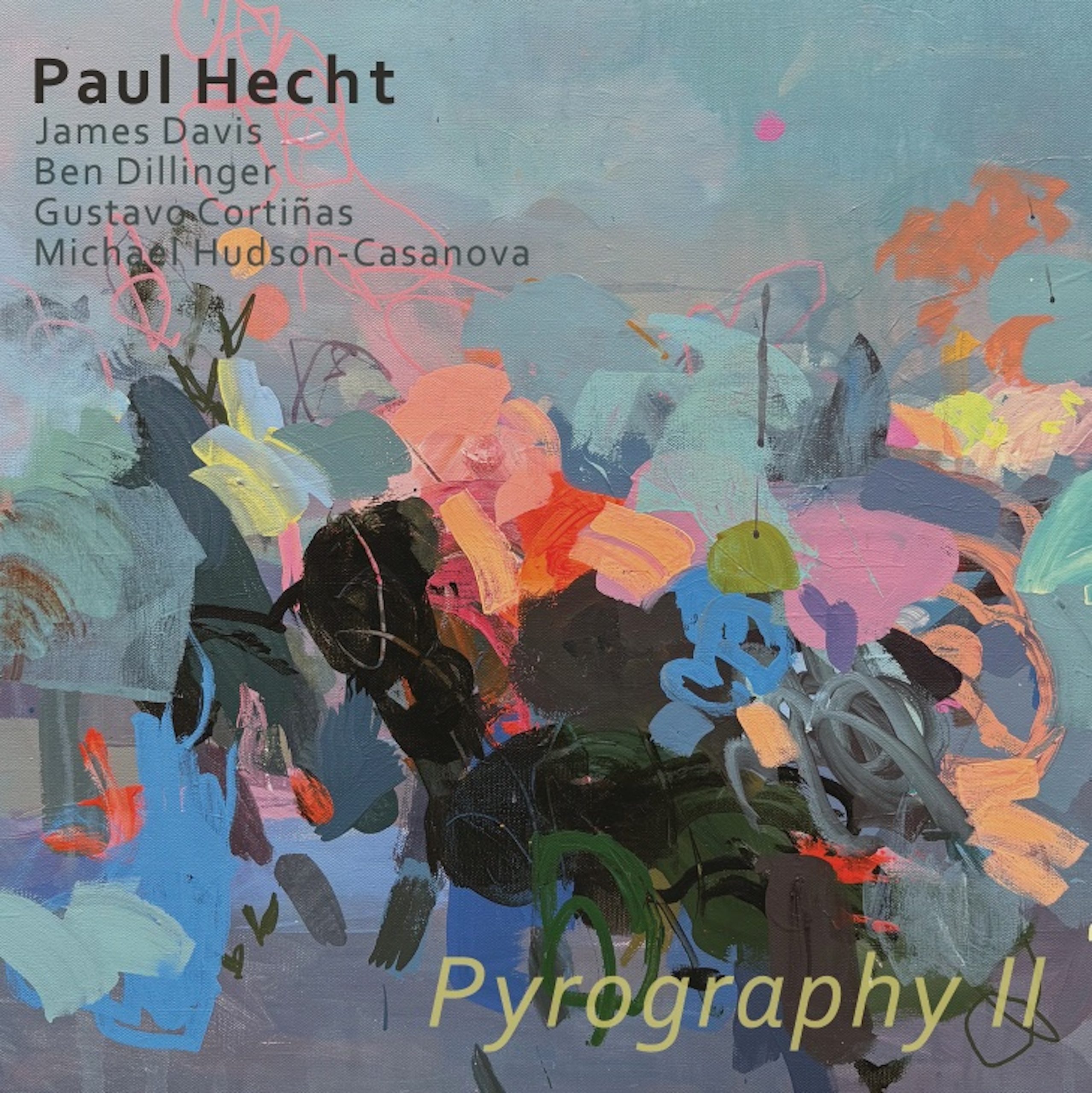
PIANIST AND COMPOSER PAUL HECHT ANNOUNCES PYROGRAPHY II, OUT MAY 29, 2026 ON EARS&EYES RECORDS
WITH BASSIST BEN DILLINGER, DRUMMER GUSTAVO CORTIÑAS, TRUMPETER JAMES DAVIS, AND ALTO SAXOPHONIST MICHAEL HUDSON-CASANOVA
A FOLLOW-UP TO PYROGRAPHY EXPANDING INTO QUARTET AND QUINTET SETTINGS SHAPED THROUGH LIVE PERFORMANCE
Pyrography II is the forthcoming album by pianist and composer Paul Hecht, out May 29, 2026 on ears&eyes Records. Hecht joins bassist Ben Dillinger, drummer Gustavo Cortiñas, and trumpeter James Davis, with alto saxophonist Michael Hudson-Casanova joining on select tracks, shifting between quartet and quintet settings. The expansion grew out of the band’s live sets, where the blend between trumpet and alto became a compositional focus. “I heard how beautifully Michael’s sound combined with that of James on trumpet,” Hecht says, “and I wanted to write for them.”
Before turning fully to music, Hecht spent years in academia. He studied at Amherst College with Yusef Lateef, then completed a joint PhD/MFA at Cornell, where he studied poetry and poetry writing. He went on to teach English, direct and teach theater, and publish What Rosalind Likes (Oxford University Press, 2022). He left academia in 2020 to focus on composition and performance.
His writing develops through long-form structures, juxtaposition, and revision — ideas worked out, broken apart, and reassembled in rehearsal and performance. Hecht also draws on his background in theater and directing, shaping the band around the strengths of the players. Pyrography took shape as a working band with Dillinger, Cortiñas, and Davis; the addition of Hudson-Casanova extends that approach into a larger ensemble.
Hecht calls the album “a more outward-facing record, a bigger discussion.” On the first record, he worked from an abstract vocabulary partly derived from Prokofiev, using outside material as a kind of provocation. Here, he pushes further toward an abstract language that feels like his own — most clearly in pieces like “Seriously” and, to a lesser extent, “LDD,” where dense written lines place near-impossible demands on the musicians and open the music in performance.
But that’s only one side of the record. Elsewhere, the writing leans into direct lyricism and simpler materials, often drawing on the romantic strain of the contemporary Chicago scene and indie-folk sensibilities. In pieces like “Hero Complex,” those elements sit alongside — and sometimes against — more demanding language, giving the album its internal tension.
Playing music from trumpeter Dave Douglas’s Infinity and hearing him perform with saxophonist Joe Lovano formed another clue to Hecht’s sense of quintet possibilities, leaving him with a sense that the material could be continually broken apart and recombined. The album’s title, from poet John Ashbery’s “Pyrography,” remains a reference point. The word itself means “fire writing,” a fleeting mark that parallels improvisation, where seriousness and irony coexist. This, Hecht says, is an apt metaphor for jazz. He also notes Ashbery’s special talent for mixing kitsch and camp elements into new amalgams, for pressing through irony to something earnest and real.
The album includes three standards — “Countdown,” “Like Someone in Love,” and “My Romance” — juxtaposed with new compositions. Collective improvisation runs through the album across both quartet and quintet settings. “Seriously” builds from an extended line designed to challenge the ensemble, with Cortiñas shaping the rhythmic motion and transitions — “he doesn’t play a groove; he plays the music.” “Wayne” brings together contrasting materials, shifting abruptly when James Davis’s solo enters.
“Hero Complex” draws on harmonic ideas from the contemporary Chicago scene alongside indie-pop references, including Phoebe Bridgers, while pushing against the idea of heroism in improvised solos. Elsewhere, “Femme R,” first heard on Pyrography, returns in a quintet arrangement shaped through performance, where the form stretches in ways worked out onstage.
The standards function as starting points. “Countdown,” built on Coltrane’s harmonic framework, becomes a vehicle for group improvisation. “Like Someone in Love” is reharmonized. “My Romance” appears as “My Chromatic Romance,” with its structure exploded and extended into longer ensemble passages.
The quartet tracks narrow the aperture. “WWFH” is a ballad featuring an extended bass solo; “A Lullaby” focuses on ensemble sensitivity and lyricism. “LDD” (Low Dissonant Development) unfolds as a nocturne built from, as the title indicates, sustained, dissonant textures; for the session, Hecht asked Davis to approximate a close violin double-stop on trumpet, producing exotic sounds, harmonies, and employment of breath: “The instrument fights back, but in a fascinating way.”
Hecht shapes the music with the band in rehearsal and performance, responding to how the players handle the material. “The thing to do is to keep reshuffling possibilities,” he says, “reconfiguring to bring out new combinations and energies.”
Tracklisting
- Hero Complex
- My Chromatic Romance
- LDD
- Seriously
- Wayne
- WWFH
- Countdown
- A Lullaby
- Like Someone in Love
- Femme R