
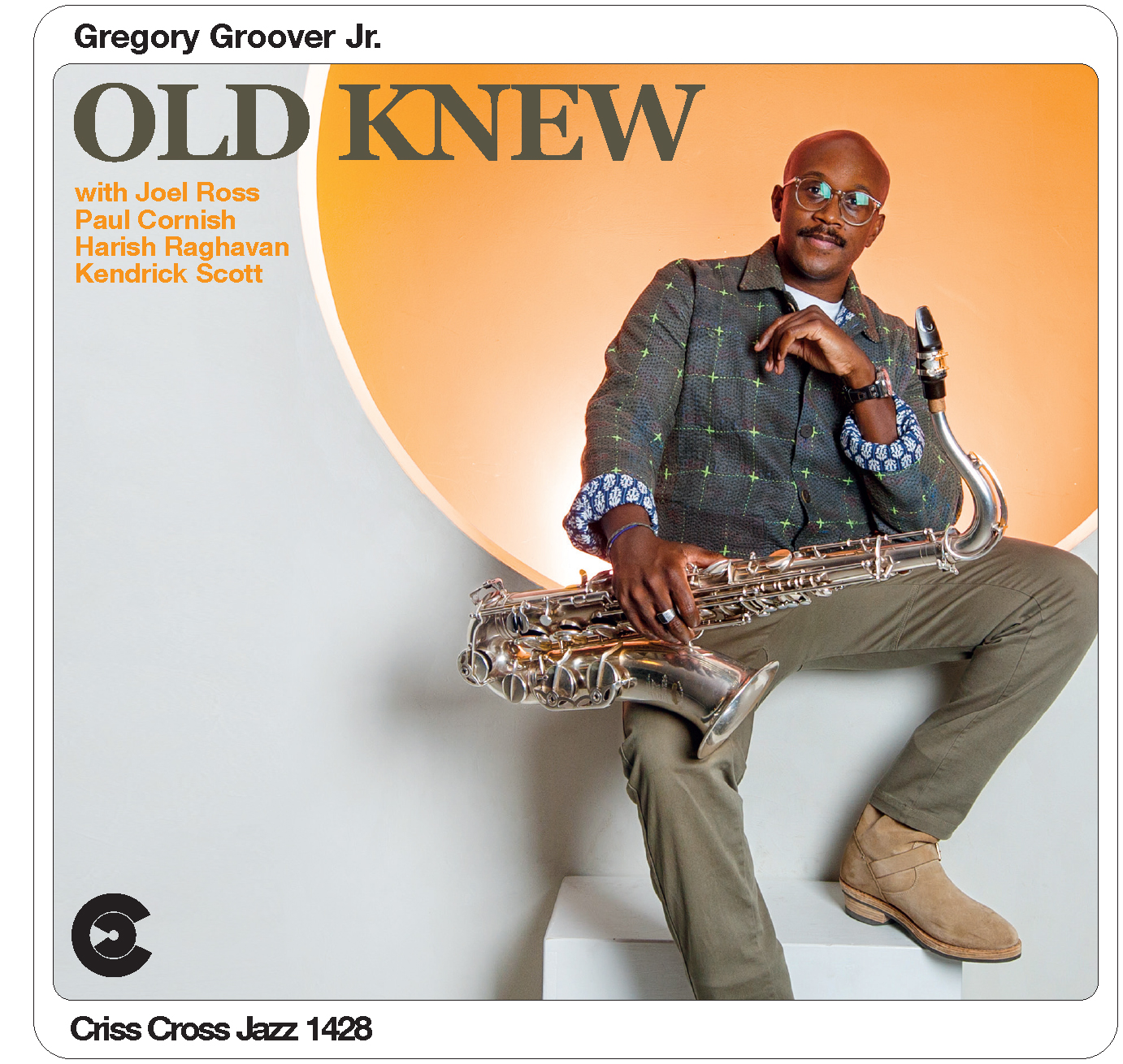
GREGORY GROOVER JR. EMBRACES TRUST AND INTUITION AS HE EXPLORES NEW MUSICAL TERRITORIES WITH OLD KNEW – OUT NOVEMBER 7, 2025 VIA CRISS CROSS
Criss Cross is proud to announce the November 7, 2025 release of Old Knew, the latest release by saxophonist and composer Gregory Groover, Jr. Old Knew is Groover’s follow-up to his 2024 Criss Cross debut, Lovabye, on which – in the exalted company of Joel Ross, Aaron Parks, Vicente Archer and Marcus Gilmore – he projected his soulful, reflective tenor saxophone voice throughout an 11-track recital of, as Groover puts it, original “love songs and songs of people I love.”
On Old Knew, Groover, 32, addresses similarly inspired repertoire from a different angle, eliciting collective kineticism and creative spirit from a pan-generational A-list quintet, comprising Ross, the nonpareil 30-year-old vibraphonist; Paul Cornish, the 20-something pianist; and the glorious drummer Kendrick Scott and bass provocateur Harish Raghavan, both 40-something. The first three are Blue Note label-mates of Groover’s producer, the eminent saxophonist Walter Smith, III, once the leader’s hero, now his fellow faculty member at Berklee College of Music, where Groover serves as Assistant Chair of the Ensemble Department and, for much of the 2024-25 academic year, Interim Director of Danilo Perez’s Global Jazz Institute.
“I’m proud of Lovabye because there’s a cohesive theme, which I set out to do,” Groover said in late July, a few days after returning to the U.S. from a fortnight in Perugia, where Berklee stages clinics during the Umbria Summer Jazz Festival. “There’s also a theme on this record, but I wanted the energy to feel different, less about the written composition and the mood, and more about the interaction and my playing.” Towards that aspiration, Groover wrote or arranged another 11 pieces tailored to the idiosyncratic tonal personalities of his bandmates, who color and characterize the music.
“The title comes from an affirmation I once wrote to myself when traveling,” Groover says. “The idea is that what sparks an artist’s interest, whatever your line of work, impacts what you want to pursue thereafter. I remember the first time I heard Wayne Shorter’s ‘Witch Hunt’ and decided to switch to playing tenor. I remember the first time I heard Walter’s and Ambrose Akinmusire’s music. I always wanted to make my version of whatever would make me or make someone else feel that way. I care deeply about this music and the musicians who’ve given their lives, and I want to continue to add to it myself.”
The process of conceiving, executing and digesting Lovabye has helped Groover to “develop a stronger sense of self and belief” that underpins this offering. Perhaps that accounts for Smith’s remark, “You hear a lot of patience in Gregory’s writing and playing on this record; he’s not trying to prove anything, just playing the song.”
Groover says: “I’m trusting my vision and intuition, that what I’ve known from day one is (a) enough and (b) was right, even though the way I play may be different because of my upbringing, where I’ve lived, the people I’ve encountered. The other side is trusting the wisdom that older musicians – members of my church, teachers, and so many other spaces – have poured into my life.
Groover approached the recording without rehearsal, sending music in advance and encouraging the band to let spontaneity guide the session. He describes the outcome as deeply meaningful, bringing in surprises he couldn’t have planned.
The namesake son of the pastor of Boston’s venerable Charles Street A.M.E. Church, Groover learned the codes of off-the-cuff, cogent, compelling musical storytelling from the pulpit and the choir, as documented on the exceptional 2019 album Negro Spiritual Songbook, Volume 2 (The Message), containing his arrangements of “Black America’s praise music through jazz’s evolving language to produce a radical theology that connects you to a higher power.” Pérez, who mentored Groover when he matriculated at Global Jazz Institute midway through the 2010s, recalls: “From the beginning, I noticed Greg’s connection with the spiritual side of music and the music’s roots. His tone is so warm, so expressive, reflecting the vocal quality of church, which gives a lot of narrative direction. He plays with a lot of energy and emotional resonance, and he’s very grounded.”
For Groover, a devotee of the tenor-vibraphone front-line sound, “continuing to make and write music with Joel in mind” was a priority. “It’s not just because of Joel’s sound and approach, but because his art is so true that he can fit into any scenario and make everything better,” he says. “He took everything I did to another level and helped the band go here. But he’s also happy just playing the melody over and over again.”
The session marked Groover’s first encounter with Cornish, whose playing with Joshua Redman’s group in recent years has intrigued him. A native Houstonian and an alumnus of High School for the Performing and Visual Arts, Cornish has been an active church musician since adolescence, inculcating “the idea that you’re in service to something larger than yourself; you’re a vessel for a message.” Groover admired Cornish’s thoughtful, understated approach and saw him as an ideal balance for the band. Groover first played with bassist Harish Raghavan at his album release concert for Lovabye. “He made this music that I was so familiar with and attached to feel different,” he says. “I knew I wanted the music on this record to have a different feel, and I wanted to try to capture that energy. He plays with a lot of care, at a level of intensity that pushes the band.” He describes the wizardly Kendrick Scott, Walter Smith’s close friend for three decades, as “a deep hero, who I’ve listened to for an ungodly amount of hours over the years.
MORE ABOUT OLD KNEW
Groover highlights Scott’s dynamic contributions on “Retrograde,” Jason Moran’s modern standard from Soundtrack to Human Motion that reverses Andrew Hill’s “Smokestack.” “When we were playing, it felt like I was being hit by waves left and right, particularly on the intro and outro on the last head,” Groover recalls. “When we were done, Walter said, ‘Damn, that was amazing.’ Kendrick said, ‘I’ve heard that tune a bunch, but that was the first time I played it.’”
Scott’s arranging instincts also surface on “Good Sir,” Groover’s nod to his father and to Walter Smith. “I wanted to write something in Walter’s style,” Groover explains. “Kendrick said, ‘I need something to help me track the form; what if, instead of playing this on the downbeat, we move it by an eighth note, to create an anticipation?’ That changed the melody’s whole vibe for me, and it’s one of my favorite things on the record. Kendrick has a great arranger’s mind.”
The album abounds with further highlights. “Spaces,” an older composition reimagined by Groover, explores “the noise in your head, the over-thinking, but also physical spaces that can create agitation or worry – and how to navigate and overcome the issue.” Cornish’s ambiguous chords and Scott’s jittery beats state the problem; whirlwind exchanges between Groover and Ross point toward the cure.
The soulfully affirmative “551” honors the Charles Street A.M.E. Church, where Groover still plays. “It’s dedicated to the people there who poured into my life throughout the years, who continued to pour into me and believe in me at the moments where I didn’t believe in myself.” Groover’s praiseful opening solo sets the tone, followed by slow-building statements from Ross and Cornish.
Scott’s galloping rhythms drive “Go For Broke,” inspired by “a sermon by my youth minister about giving an all-out effort for things we obviously care about.” Ross dances across Scott’s patterns, while Groover testifies with a rich, enveloping sound.
“Rain Shall Fall” begins as a ballad before transforming into a swinging groove, a metaphor for “navigating the seasons of your life, good and bad. You see the beauty in the rain, even though you can’t stop it from falling.” Ross delivers a flowing solo, followed by Groover’s staunch declamation and Cornish’s abstract counterpoint.
On “Sumner,” Groover and Ross trade solos in an ode to Groover’s childhood street in Boston. Family memories also animate “Juanita and Betty,” tributes to his grandmothers. “Both were beautiful, graceful, strong women, and I wanted to write something with beauty that also conveyed what their lives might have been like.” Groover responds with an elegiac solo, answered by Ross’s ebullient stomp.
“William and Vinson” honors Groover’s grandfathers, one he never knew and one he knew briefly. The piece’s staunch refrain unfolds into a march-like feel, with Cornish channeling shades of Geri Allen before Groover returns with variations on the elemental theme.
Groover began the multi-sectional title track in 2012, inspired by “pieces of Ambrose Akinmusire’s music from his first record.” Twelve years later, the first-take recording reveals both growth and continuity: “It shows me, ‘Wow, you always knew what your music wanted to be.’”
The album closes with “Arrivals,” a brisk miniature distilled from a longer suite. “Any arrival can be shaky, and maybe you’re unsure, but you’ve got to make your mark,” Groover reflects.
Derived from booklet notes by Ted Panken.
##