
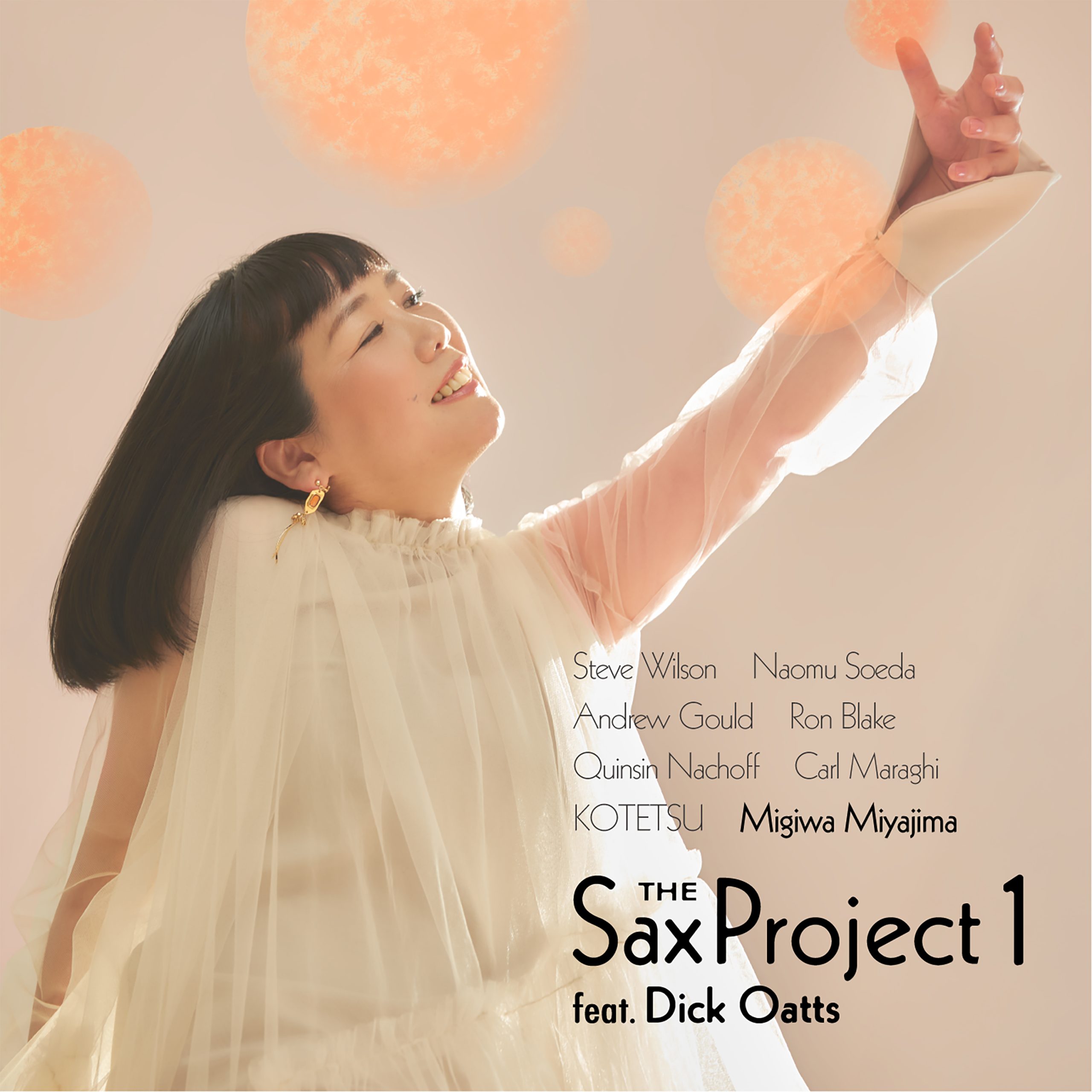
MIGIWA MIYAJIMA BRINGS LONGTIME VANGUARD JAZZ ORCHESTRA
SAXOPHONIST DICK OATTS TOGETHER WITH STEVE WILSON, RON BLAKE,
QUINSIN NACHOFF & MORE ON THE SAX PROJECT 1 FEATURING DICK OATTS
OUT NOVEMBER 13, 2026 ON SOUNDSPORE RECORDS, THE ALBUM FEATURES
SEVEN ORIGINAL COMPOSITIONS, THREE IMPROVISATIONS AND SIX
CONFIGURATIONS RANGING FROM DUO TO SEPTET
“SUPERSTAR OVERLOADED” ARRIVES OCTOBER 2, FOLLOWED BY “THE
BLOOMING SEASON” OCTOBER 16 AND “SUNSET EMBRACE” OCTOBER 30
The Sax Project 1 Featuring Dick Oatts is the new album by New York–based composer, pianist and producer Migiwa “Miggy” Miyajima, out November 13, 2026 on SoundSpore Records. Miyajima worked for more than a decade with Dick Oatts, a longtime soprano and lead alto saxophonist and musical director with the Vanguard Jazz Orchestra. Oatts joined the Thad Jones/Mel Lewis Orchestra in 1977; after Jones left the following year, the band continued as the Mel Lewis Jazz Orchestra, then became the Vanguard Jazz Orchestra after Lewis’ death in 1990. After years of working together, Miyajima finally asked Oatts to record her music.
Steve Wilson, Naomu Soeda, Andrew Gould, Ron Blake, Quinsin Nachoff, Carl Maraghi and vocalist KOTETSU complete the personnel. The album contains seven original compositions and three improvisations in six configurations ranging from duo to septet. Miyajima composed and arranged all seven written pieces. Oatts appears on four compositions, plus all three CD- and Bandcamp-exclusive bonus tracks. Three of those four compositions were recorded in July 2025, after he had publicly announced his retirement that January.
Miyajima left a career as a magazine editor-in-chief in Japan to become a full-time musician at 30. Her production work has earned multiple Grammy nominations, including two as associate producer of the Vanguard Jazz Orchestra’s Forever Lasting — Live in Tokyo and OverTime: Music of Bob Brookmeyer. She leads the 17-piece Miggy Augmented Orchestra and acoustic quartet KYMN. She has conducted for NEA Jazz Master Slide Hampton and served as one of five producers of the 2025 Celebrating Jim McNeely concert; her honors include a 2024 MacDowell Fellowship.
“Music is something to experience — to live in,” Miyajima says. “Having witnessed so much death, I don’t see music as merely something to listen to. Who I perform with, what we perform and how we perform matter deeply to me. To me, the work of a composer and producer is sacred.”
Miyajima’s history with the Vanguard Jazz Orchestra began in 2008, when she traveled to New York for the band’s anniversary week and attended every performance, sitting near the saxophone section and taking notes on its voicings and arrangements. The following year, she began producing the orchestra’s Japan tours and educational programs. That work ultimately encompassed eight tours and introduced her to Oatts and Wilson.
After surviving the 2011 Great East Japan Earthquake, tsunami and nuclear disaster, Miyajima moved to the United States in 2012 with support from the Japan Agency for Cultural Affairs and the Japan-U.S. Friendship Commission. She joined the BMI Jazz Composers Workshop that year and studied there with Jim McNeely and Mike Holober through 2015. Miyajima continued working with the Vanguard Jazz Orchestra through 2016. Two years later, the Miggy Augmented Orchestra released its ArtistShare debut, Colorful.
The Sax Project began in 2020, when the pandemic erased Miyajima’s overseas tours and television appearances following Colorful. Soeda asked her to arrange the piano piece “Exploring Discovering” for saxophone quartet. He heard Miyajima’s classical piano background in her jazz phrasing and harmonies and urged her to keep writing for saxophones. She began developing music for jazz and classical players from Japan and North America, expanding the instrumentation to include voice and piano. “The idea behind it was to bring the world closer together,” Miyajima writes.
At the same time, Miyajima was developing Unbreakable Hope & Resilience, an umbrella project based on 20 true stories from the aftermath of the 2011 disaster. Its first release was the 2021 book and accompanying music Your Future Story. The second, Unbreakable Hope & Resilience, arrived June 26, 2026, a live recording from Dizzy’s Club featuring Miyajima conducting a 17-piece big band with three actors. The interviews behind the project strengthened her determination to live without regrets. One result was a decision she had postponed for years: asking Oatts, whom she considered family, to play her music. “Perhaps because we were so close,” she writes in the album notes, “I had always held back.”
The 2023 Sax Project sessions were made possible in part with support from the Café Royal Cultural Foundation. Miyajima recorded at Sear Sound with Wilson, Soeda, Nachoff, Maraghi, KOTETSU, Blake and Oatts. Oatts initially declined, saying he was too busy. Months later, he heard Miyajima’s demos and changed his mind. “I’ve been keeping myself too busy lately, but this reminded me why I came to New York,” he told her. “Thank you for reminding me.” His response brought Miyajima to tears.
A 2025 Chamber Music America Artistic Projects grant, funded by the Howard Gilman Foundation, partially supported a second round of recording. Oatts had announced his retirement that January. With help from him and his family, Miyajima recorded with him again at Samurai Hotel Studio in Astoria on July 10. She also invited Gould, an alto saxophonist who deeply admired Oatts. Because Gould often worked as Oatts’ substitute, the two rarely had the chance to play together. Miyajima wanted to give Gould that chance. Jay Messina recorded, mixed and mastered both rounds of sessions.
Miyajima writes her composed pieces for specific musicians; every written part bears the player’s name. “I write for each person,” she says. “That’s very Ellingtonian, and it’s something I inherited from Jim McNeely.” The three Haikus work differently. For “Haiku A,” “Haiku B” and “Haiku C,” KOTETSU and Nachoff are the featured improvisers in a quintet with Wilson, Soeda and Maraghi. Miyajima supplied no written music. Instead, she cued changes in mood, intensity and direction as the quintet improvised. She planned to keep one performance; all three made the album.
“Will You Be My Friend?” comes from Miyajima’s unfinished Forgiveness suite and depicts two central characters meeting and hoping to become friends. She first wrote the piece for piano. While arranging it for saxophones, she remembered the excitement of meeting Oatts and Wilson after years of hearing them on big-band records. Wilson solos on alto and Oatts on soprano; Miyajima plays piano alongside Blake, Nachoff and Maraghi.
On lead single “Superstar Overloaded,” Oatts and Gould improvise simultaneously over a percussive saxophone groove. At Melting Cups, a Sunnyside café, a groove caught Miyajima’s ear and she began singing it to herself. She passed the figure across the saxophones, left Oatts and Gould room to improvise over it and added her own vocal percussion. “We all have to be a drummer,” she says. “On paper, it’s not difficult. But when you play it, you have to really groove.”
Miyajima wrote “My Yellow Blues” in response to racism she has experienced as an Asian woman in the United States. During the pandemic, strangers shouted racist abuse at her and physically harassed her in public. She also recalls seeing disbelief when mentors introduced her as a producer, conductor or bandleader. Miyajima chose Wilson, a cherished older-brother figure in her life, and Japanese saxophonist Soeda for the alto-and-soprano duet. “The piece is my outcry against the racism I have repeatedly experienced as an Asian woman,” she writes.
Miyajima had performed “If I Could See Thad” as a combo piece for more than 20 years before arranging it for saxophone quartet. She never met Thad Jones, but musicians who had worked with him repeatedly told her they wished the two could have known one another. “It’s like a grandpa who passed away before you were born,” she says. Oatts’ history with the Thad Jones/Mel Lewis Orchestra gives the recording a direct connection to Jones. For this version, Oatts brought an old soprano saxophone without a strap because he believed its sound fit the piece. Three rehearsal takes appear as CD- and Bandcamp-exclusive bonus tracks, preserving three additional Oatts solos.
Miyajima wrote “Your Light Pours Through Every Gap” specifically for the 2025 session. Oatts plays alto. She wrote the score to give each of the other musicians a brief, intimate stretch of unison time with him, one at a time. “I learned from this recording session that, as a composer, what I can give to the players is time shared together,” Miyajima says. “When you play unison, you need to really be together with that person. I wanted to give all of them this moment.” Oatts kept sending her messages about the melody after the session: “That ballad is wonderful.” “I still catch myself humming it.”
String quartet ETHEL commissioned “The Blooming Season” for itself and flutist Allison Loggins-Hull. The piece depicts spring, when new life emerges. For the Sax Project version, Miyajima adjusted the phrasing for saxophones and gave KOTETSU the vocal feature. She hopes the recording will introduce the Japanese vocalist to more listeners in the United States. When Miyajima played KOTETSU’s work for Rufus Reid and Billy Childs, both asked the same question: “Who is this?”
Miyajima wrote “Sunset Embrace” for Blake. She experiences synesthesia; particular notes in his tenor saxophone appear to her as orange and yellow. Watching a sunset over the Hudson River, she recognized those same colors in his sound. When she told Blake, she learned that his late mother had taken up photographing sunsets in her later years, creating collages from the photographs and framing them for the house. Miyajima plays piano on the sextet performance; Blake takes the tenor solo.
“I truly believe there are two kinds of music,” Miyajima says. “One sounds cool. Another shakes your heart. I think the difference comes when a group of people in a recording session respect each other and love each other. I’ve seen it in every recording session I’ve attended, and I think that miracle happened here. I want listeners to catch that.”
Tracklisting
- Haiku A
- Will You Be My Friend?
- Superstar Overloaded
- My Yellow Blues
- If I Could See Thad
- Haiku B
- Your Light Pours Through Every Gap
- The Blooming Season
- Sunset Embrace
- Haiku C
CD/Bandcamp-exclusive bonus tracks:
- If I Could See Thad (Rehearsal Take 1)
- If I Could See Thad (Rehearsal Take 2)
- If I Could See Thad (Rehearsal Take 3)